As I’ve
admitted before, back when Mangagamer announced its partnership with
Softhouse-seal, I wasn’t that thrilled about it since the lineup didn’t exactly
look that enticing. Sexy Demon Transformation however managed to prove me wrong
and now I have to admit I’m looking forward to what this new company has to
offer (and anyone else who’s been paying attention to MG’s plans for 2013 can
see they have quite a bit down the line). So as you can expect, I had good
expectations once I’d downloaded and installed my copy of the next in the
Softhouse-seal English lineup, Boob Wars, released in English on October 19,
2012. After playing it…I can at least say it’s a decent time killer.
Pros: Fun card battle system, good artwork, some of the
jokes are funny, Teresa makes for a good heroine.
Cons: Not as funny as I was hoping, characters aren’t really
used that well, the harem ending pretty much makes the other two endings kind
of pointless.
WTF?!: I hear this every time I tell people I don’t really hate
Mass Effect 3’s ending with the Extended Cut…
You
know considering there wasn’t much point in a summary for Sexy Demon
Transformation, I’ll opt to quote Mangagamer again:
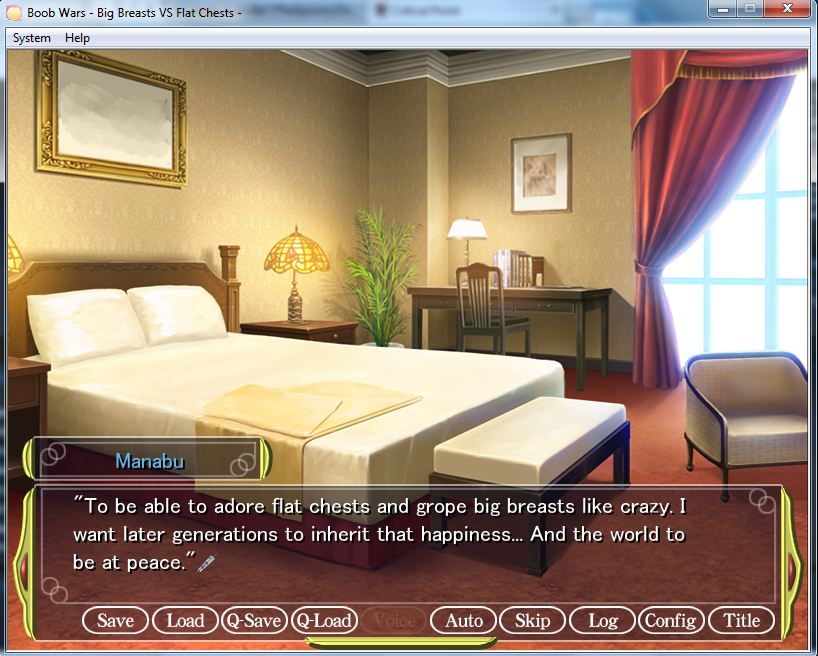
“At the beginning of the 22nd
Century, an anomaly began occurring in the bodies of women...
All the women of the world became either E Cups and up or A cups and under.
"Big Breasts" and "Flat Chests"... Due to their division
into these two groups,
the debate over which was superior began.
After the first incident of armed conflict, known as the "Nyuuhen
Tragedy,"
the entire world was split between the Big Breasts Tribe and the Flat Chests
Tribe and an intense conflict ensued.
87 years later...
The secret organization of Erorists, "Eagle", has ordered our
protagonist Takamura Manabu to pursue the mission of his career: "Seduce
Queen Milk Elioto of the Big Breasts Tribe and Queen Teresa Premadasa of the
Flat Chests Tribe and bring this war to a close."
"Eagle" immediately sent the Erorist, Takamura Manabu, to the two
queens!!
Can Manabu stop the two queens and bring this war to an end!?”
And
that’s basically this game’s story…but considering this is softhouse-seal, a
story with depth is not to be expected. Really, in a light hearted sex romp
game like this, what you should hope for is that the characters are likable and
the humor works. As for how Boob Wars handles those…I’d say it really only does
an okay job. With the characters (click here for profiles), most of them are
just passable since while all the characters with a character portrait are
given a personality, it’s really only Milk and Teresa who get the mostsignificant screen time while Suzuka and
Sophia get significantly less. This is further confounded by the fact that Milk
isn’t all that interesting as a character either. Really, aside from Teresa the rest of the cast
is pretty forgettable.
Now
I realize that this game isn’t supposed to have deep characters considering its
genre and shortness, but SDT was able to have characters that were memorable
and they all got a fitting amount of screen time and humorous scenes and it’s
about the same length as Boob Wars. While we’re comparing the two though, I
should also point out the Boob Wars isn’t as funny as SDT. Don’t get me wrong,
it has a good enough amount of jokes to make me chuckle, but for every funny
joke there’s a joke that falls flat or I simply just don’t get. I think part of
the reason is because the jokes in SDT had a better focus on what it was making
jokes about: the ridiculousness of the monster rape genre of eroge.
Concerning
the routes of this game, there sadly isn’t much to talk about considering the
individual endings for Milk and Teresa are obviously fake endings with the
harem route being the true ending. I can say that if not for the last part of
it, Teresa’s route is pretty good considering she has some good interactions
with Manabu that I found cute and kind of funny. Can’t really say the same for
Milk since like I said before she isn’t that interesting and the same can be
said of her route. The harem route, while better than Milk’s, is just okay.
As
for the gameplay, this is where Boob Wars actually does its best as throughout
the game you battle enemies in a card based game similar to Princess Waltz
where you and your opponent alternate between attacking and defending,
receiving two randomly picked cards each turn. In each phase you can use up to
three cards and the combined numerical value of each card determines how much
damage you do when attacking and how much you block when defending. If the
value of the attack exceeds the defense, a lot of damage is inflicted but if
the value of the defense is higher then only a few points of damage are dealt
if any. While the battle system is simple it can actually be pretty fun,
especially on hard mode where you actually do have to put some strategy into
fights such as how may high number cards should you use for attack vs. defense.
If you don’t want to play the story again, but want to just play the card battle’s
there is a free battle mode in the extras section.
In
the area of presentation, I’d say the artwork is pretty good as is the voice
acting even if the music is pretty forgettable. As for the ero scenes, they’re good, but
nothing special.
In Conclusion:
Boob
Wars is an overall okay game that won’t be a waste of your money if all you’re
looking for is a sex romp game. The gameplay element is a nice addition and may
have you playing the game even after you complete the story mode. I will admit
some of the humor may not be for everyone, but it gets enough laughs to be a
passable comedy in my book. There are better games in MG’s lineup though, so I
recommend only getting this if you want something to pass the time until the
next big title releases.
Ever
since I played Kara no Shoujo I’ve been hungry for another mystery themed
eroge. Of course I could always get something from Innocent Grey’s library, but
I wanted to see if any other companies had anything to offer. After a bit of
looking, I found Caligula Soft’s Shinsetsu Ryouki no Ori, a remake of a game
from Nihon Plantech that came out in 1995 under the name Ryouki no Ori. I admit
what got me to take a look at it was the 90s style anime artwork for the
characters, but the story was what got me interested in trying it out. Having
completed it, I can say it’s a pretty good game overall, but…
Pros: Story is interesting for the most of the game, core
cast is memorable and interesting, really good artwork, excellent voice acting.
Cons: The true ending route, the free roaming game mechanic
starts to get annoying after a few playthroughs, the side heroine routes are
hit or miss storywise, insultingly short ero scenes.
WTF?!: An amusement park with an attraction area based off
the Cthulhu mythos?* If only Astroworld had had that it would still be
around... ;_;
*Not joking, Misuzu’s saying that the next attraction
they’re going to is “Shoggoth’s Tea Party” in the R’lyeh Area.
In
Shinsetsu Ryouki no Ori you play as a detective (who you can name) hired to
investigate a series of mysterious disappearances that have occurred in the
Zeroshiki Department Store for the past 15 years. Said detective is to go
undercover as a new employee in order to conduct the investigation and has nine
days to try to solve the mystery.
When it
comes to story, SRO does a pretty good job for the most part. The mystery
surrounding the disappearances is intriguing and each revelation you uncover
related to it from multiple playthroughs does have you interested in seeing the
resolution. Each of the main heroines is tied somehow to the mystery
surrounding the disappearances and completing each of their routes gives you a
feel as if you’ve obtained another piece to a puzzle that will come together
into a big reveal. It also helps that most of the main heroines’ stories are
interesting by themselves and the relationships they form with the MC are
believable from their interactions with one another to the protagonist’s role
in helping them deal with a major problem.
Ignoring
the True Ending route (which I’ll get to soon enough), my route preference is
as follows:
1)Tsukasa
2)Nobuko
3)Makoto
4)Akira
5)Shizuka
6)Rebecca
7)Uzuki
8)Misuzu
9)Yori
10)Kurara
To be honest, Tsukasa and Nobuko
almost tie for first place as I enjoyed both of their stories from how their
stories are tied to the main mystery to the role that the MC has in solving
their problem and how that leads into a pretty satisfying conclusion to their
character arcs. What makes Tsukasa win out over Nobuko though is I think her
relationship with the MC is better developed; while over the course of both
routes the girls open up to him, Tsukasa’s scenes do a better job at showing
how close the two become. Makoto comes in third as her route does a really good
job in getting you interested in what the true ending of the main mystery could
be thanks to the story revelations in it, plus the chemistry between her and
the MC is really nice too. Akira’s route I like for similar reasons, but I feel
like it focuses a little too much on the mystery over the relationship
development which makes it feel a bit unbalanced compared to the previous
three. It’s the opposite with Shizuka’s route, which has some good character
development, but the mystery sadly takes a back seat to it. Rebecca and Uzuki’s
routes come in next as they both have good stories for side routes that don’t
really have anything to do with the main story and the relationship they form
with the main character is pretty believable, though between the two I’d say
Rebecca’s route has a more satisfying conclusion. As for Misuzu’s route…I’ll
talk more about that in a little bit but as a route it’s just okay, but is
pretty mediocre as a main story route. Yori and Kurara’s routes are sadly the
weakest as both are very short storywise and because of that and the fact that
they have no connection to the main plot makes both routes feel out of place.
Of the two of them though, I suppose Yori’s is a little better since that route
seems to at least have some hints of effort at telling a complete story.
Having
said all that, you can probably guess that one of the things that help to make
this an enjoyable read throughout each route is the game’s large cast of
characters, and that doesn’t just include the heroines as throughout the
game you can have the MC interact with the store’s security guards, different
shopkeepers, and even a burglar to name a few. Such a large cast helps in
giving the store setting a populated feel with each having their own unique
personality to match their looks and the number of different scenes you can get
through interacting with these characters at certain times of the day does help
to enhance the replay value be they serious scenes that may or may not shed
light on the case or lighthearted scenes such as a race through the store on
forklifts (and of course…).
That
said, the game has its share of story problems, most of them concerning the
true route. Now I’ve mentioned before the general problem I have with a
multi-route game with a true ending and how it can end up cheapening, or at
worst invalidating, the other routes. Sadly, SRO’s true ending is the kind that
completely invalidates the other endings and doesn’t even seem to acknowledge
them in any way. This really devalues the playing of the other routes if you
played them first as the buildup that they seemed to hint at just falls flat as
a result, and if you just play the only route necessary to unlock it, Misuzu’s,
then play the route it makes playing the other routes seem pointless because
now that you’ve solved the mystery the other routes just come off as fake and
pointless in the end.
Speaking
of Misuzu, this is where I’ll be talking about why her route doesn’t rank very
high amongst the others in my book as the true route is essentially a truer
version of her normal route.To put it
simply, as a heroine Misuzu is pretty boring for this kind of game. Unlike the
other main heroines, Misuzu doesn’t have any personal secret tied to the main
mystery, her only connections to said mystery are really through her parents and
as a result her involvement in the overall story is next to nil. I get that in
the true route the writer was probably trying to portray her as a normal
innocent girl suddenly thrust into the events store’s dark and ultimately
tragic history by circumstances beyond her control, but it’s Misuzu’s normalcy
that ends up foiling that, especially if you’ve played the other routes. In
those routes, the heroine’s having some sort of personal connection to the main
mystery (in most cases a personal problem) actually helps to create an extra
stake in the case other than just solving it as you now want to see things turn
out well for said heroine too. Basically you get more invested in the story
this way, but with Misuzu not really having that the only thing you have to be
invested in is in seeing the mystery itself solved. And sadly, the true route
manages to fumble that too…
The
main reason the main mystery doesn’t turn out so well is because a lot of it is
dependent on the reveal of another culprit aside from the one revealed in the
other main routes. This is supposed to be a big plot twist, but unfortunately
it’s not a very effective one for a few reasons. First, while the reveal makes some
sense initially it raises several questions concerning how it relates to the
overall plot that really make it seem like the only reason the culprit wasn’t
revealed in the other routes was a series of really hard to swallow plot
conveniences. Second, the secret culprit’s motivations are pretty weak
considering who that character is and even weaker when compared to those of the
main culprit in the other routes. Third, the reveal only serves to create too
many villains, and since the revealed culprit isn’t a very effective one you’re
left wondering if this reveal was really necessary.
Another
fumble on the true route’s end is that it tries too hard to play up the tragic
elements of the story by trying to make the player feel sorry for the villains.
It wouldn’t be a problem if it were done well like in Detective Conan ,
but SRO’s villains just aren’t that sympathetic. The secret culprit’s
motivations don’t really show that character as anything but despicable, one of
the villains just comes across as a raving lunatic (and that seems to be his
main motivation too) and not very sympathetic, and one villain who’s really just
a henchman kind of villain doesn’t get much in the way of personality or story
outside of his being a flunky until right before he dies where he does a
ridiculously long inner monologue of his life story (and yes, that scene is
meant to be taken seriously). Only one villain character comes off as being
anything close to sympathetic, and that ends up being undermined by the fact
that in the bad endings that character does some pretty nasty things to the MC
and the heroines without a moment’s hesitation and even ignoring those endings
what sympathy you may have for that character pretty much goes away when you
consider how that character’s actions will affect another of the characters.
Concerning
the gameplay element, when you’re in the department store you actually get
control the MC from an isometric perspective where you click to where you want
him to go and proceed to other rooms and floors by clicking an icon that
appears above the MC’s head. This is also how check for clues, talk to people
and even find some hidden secrets and characters throughout the building. What
you find and who you meet are determined by the time of day, which passes
according to where you go to and how much time a scene can take. There’s also a
database on the characters you meet in the store that updates as you go along
in the game. For the most part this makes for a fun way to explore, but it
sadly starts to get tedious after a few playthroughs, especially when you’re
trying to get to specific events so you can unlock a route. In fact, the true
end route practically demands perfection when it comes to the scenes you have
to see and the times you need to make, and even with a walkthrough handy (which
belive me you WILL need) it
still feels like a chore considering if you miss even one of these scenes
you’re going to get a bad end. Also there is a bit of a problem where sometimes
the game doesn’t detect your clicking the icon and instead moves the character,
but it doesn’t happen that often. The game does give the option of using a map
of the store to fast travel to whatever area you want to go to, which does make
things a little less tedious.
I
should point out that the game does have a few system problems such as occasionally
crashing when saving or loading, plus the skip function skips over any text
when selected regardless of whether or not you’ve read it before. Unfortunately
there doesn’t seem to be any way to change that in the configuration menu. This
makes for a problem during replays as it means you have to commit to memory
whether you’ve seen certain scenes before or not and also keep an eye out for
any changes to scenes depending on what you’ve done previously. Fortunately
there weren’t very many cases of that which I could remember.
In the
area of presentation, SRO does a good job for the most part. The artwork for
the characters has that 90s anime look about it which really helps in showing
how the characters are all drawn in a unique way. The music is probably the only weak point when
it comes to presentation as it’s really just okay and not very memorable
(though the opening was pretty good). The only track I wasn’t fond of was the
ending theme as it just seems to go on forever much like the credits it
accompanies. The voice acting is great all around with everyone but the MC
being voiced and the voice actors all do a good job with the roles they’re
given. The one voice actor that does stand out though is none other than THE
Norio Wakamoto himself as security guard Takeshi Saito, giving a good performance with both the
funny and dramatic scenes that his character is in with the voice that many of
us otaku have come to love.
As for
the ero scenes, they’re not bad, but most of them are extremely short,
consisting of 1-2 CG and some lasting only a few minutes. For a game that came out
in the 90s that’s fine, but considering this is an updated remake you’d think they’d
extend the ero scenes even a little bit more from that.
Characters:
Makoto Zeroshiki:
In charge of the department stores owned by the Zeroshiki
family, and the one who hires the MC to investigate the disappearances. While
her job managing the stores keeps her busy, Makoto makes it her business to
know her employees and their concerns.
Tsukasa Takenaka:
In charge of the meat department on the lower level of the
store, Tsukasa began working part time at Zeroshiki while a student and became
a full time worker after graduating. As a result, she’s a very experienced
worker despite her age and hard working to boot. Many of the customers and
employees know her for smile and positive attitude.
Akira Kono:
In charge of the women’s clothing department on the ground
floor of the store, Akira is considered the “face” of the department store due
to her looks and talents which have made her very popular with customers,
especially women. Many who know her
describe her talent as being able to approach and handle any situation calmly,
like a machine.
Tamaki Ayamoto:
In charge of the men’s clothing department on the second
floor, Tamaki is one of the senior members of the staff, having even worked as
an assistant to Makoto’s grandfather, the previous owner of the department
store.
Misuzu Ayamoto:
A second year student working in the department store part
time, Misuzu’s main responsibilities are assisting her mother, Tamaki. A
cheerful and upbeat girl, Misuzu gets along well with most of the staff and is
good friends with Tsukasa and Akira.
Shizuka Kisaragi:
The head chef for the department store’s Italian restaurant
located on the fourth floor, and was hired due to her studying cooking in
Italy. Has a fine sense of cuisine, but has a tendency to be blunt about
things.
Nobuko Maeda:
In charge of the pet shop “Puni Puni” located on the fifth
floor, Nobuko can be described as an animal lover (especially of cats) and is very
devoted to her job. Despite her tomboyish personality,Nobuko is very sociable and gets on well with
both customers and colleagues alike.
Kurara Sanada:
Zeroshiki Department Store’s elevator girl, Kurara is very
popular with the male customers due to her looks and voice as her duties also
include giving information to new cutomers about the store.
Uzuki Bando:
The younger sister of Hayato Bando, one of the employees
working in the women’s department store. Hangs around the department store as
it’s a convenient place for her to meet her brother who she seems to idolize.
Rebecca do Monpal Nasu:
The daughter of one of the senior employees in the men’s
clothing department, Rebecca is considered a protégé for having studied abroad
at a prestigious university in the UK. Isn’t very good at socializing with
others and is usually seen helping her father.
In Conclusion:
Shinsetsu Ryouki no Ori is overall a good, but very flawed,
game. While its true ending is its biggest hiccup and the time management
aspect can make things tedious, there is a lot to be appreciated from its
interesting cast of characters, its 90s style artwork, and the many extra
scenes one can unlock by simply exploring the store. I would say it’s worth
getting should you happen across it on an import site, but be sure of both the
price and the flaws I’ve mentioned before you get it.
When Hakuoki
~Demon of the Fleeting Blossom~ came out last year, for many it made for an
excellent introduction to the otome game genre and for me it was an excellent VN
all around (as you can see from this review). The characters were all likable and interesting, the artwork was
great, and the stories for each route were good reads. So when I heard that
another Hakuoki game had been licensed for English release, naturally I was
excited as it promised gameplay in the style of Dynasty Warriors and two
different story modes: one a retelling of the original game’s story and the
other a completely new one with two new characters. After its release date of
February 14, 2013, I began playing my copy and…it’s been a long time since I’ve
been so disappointed by a spin off to a game I enjoyed.
Pros: Uses scenes
from the anime in the main story mode well, Chizuru is voiced
Cons: Only
“Shinsensgumi Memorial” can be considered a real story mode, in Memorial only
Hijikata’s story is handled well, gameplay is monotonous, audio lags at points,
the camera while adjustable is still an annoyance.
WTF?!: I got through this crappy game I preordered and all I
got from it was this stupid bandana…
This
would be where I would give you guys a summary of the game’s story, but in this
case there’s really no point to it. While it boasts having two story modes,
Warriors of the Shinsengumi has about the same story as the first game
regardless of which story mode you pick: Shinsengumi Memorial, which is
basically an abridged collection of the routes from the first game except now
you play as whichever hero you choose, or Shinsengumi Chronicle, which is
supposed to be (that being the key phrase) an entirely new story for each hero
set in an alternate universe where you can apparently change things from the
original story. This arrangement sounds good at first, in fact it was what got
me excited for this game as sounded like I’d get to see new stories for the
characters I’d grown attached in the original game and this time play as them.
The problem is for the most part Warriors of the Shinsengumi fails to deliver
in both modes.
Since
it was the story mode I was most looking forward to, let’s start with
Shinsengumi Chronicle. Despite how it’s advertised, the story doesn’t differ
all that much from the original; you can’t change the outcome of the revolution
that produces the Meiji era (at least not visibly unless you know Japanese
history really well) and to be honest this story mode is just plain confusing
because it barely is a story mode. The
scenes that occur at the beginning of each chapter/level are incredibly short
with the only context to why they’re occurring being a short summary of events
just beforehand that doesn’t change regardless of who you play as. There are a
couple scenes in between the start and end of the chapter/level, but the lines
of dialogue in those you could literally count on your fingers. These short
scenes really hurt this mode’s story in two ways, first it makes whatever new
story additions that there are ineffective to just plain unnoticeable, and
second it makes the story confusing. For
a good example for both, this mode introduces two new villain characters to
essentially be stage bosses, Takamori Saigo (who wields a heavy machine gun)
and Kogoro Katsura (who wields a sword). These two are actually significant
historical figures in Japanese history, but you’d be forgiven for not knowing
that and assuming they were just two characters made up for this game because
there isn’t even an attempt to give these two any character depth as they have
maybe twenty lines of spoken dialogue in the entire game and no explanation of
who they are or why they’re important because that nifty little glossary from
the original game that helped to give players context to the historical side of
the story is now gone. Even as throwaway villains these two are badly written
in as there were several points where I assumed these characters were dead
after a boss fight with them, considering the brief dialogue, but later they
appear again alive and well for another boss fight with no explanation
whatsoever as to why. Another example for how confusing this story mode is
would be how Chizuru is barely in this (which is odd considering who the final
boss is); I even thought the alternate universe aspect was she didn’t exist in
this continuity until in Hijikata’s story she popped up near the end for a
couple seconds and then just disappeared never to be mentioned again and in
Heisuke’s story she’s hinted at and never even mentioned by name.
As for
the Shinsengumi Memorial story mode, that one actually is more like a story
mode with longer scenes and the story is actually coherent. Now while it’s
supposed to be an abridged take on each route, only Hijikata’s route is handled
well in that aspect (which I admit makes sense since the anime follows his
route). Sadly the other routes feel chopped up rather than properly condensed
like Hijikata’s. For example, Saito’s completely ignores his motivation for
becoming a swordsman, Sanosuke’s edits out the parting of ways between him and
Shinpachi, and Kazama’s alliance with Chizuru and Heisuke and subsequently the
subplot concerning him and Sen is also not there. This sadly reduces the other
stories in this mode to almost a chore to complete and really has you wondering
why you’re not just playing the original game instead.
Concerning
the gameplay, I have to say Warriors of the Shinsengumi fails on this front too,
falling into the pit of monotony. Combat is basically button mashing of the
square and triangle buttons, occasionally using a charge attack, and unleashing
a special attack which you can unleash after your sakura meter charges enough,
all while either moving to the next goal/boss or fulfilling the “kill x number
of enemies” goal. Part of what makes
this so boring is how easy this is (I actually recommend playing normal or hard
since I’m pretty sure you could beat easy mode with your feet at the controls),
but thereal killer is how you don’t
feel much difference between playing each character (with one exception) as
they’re almost all swordsmen whose weapons look about the same. Sure they each
swing their sword differently and there are differences in their special
attacks, but since you spend most of the time button mashing, it largely feels
the same. The only time I felt like I was having fun was when I played as Sanosuke since he uses a spear, and
in that case I’m sure it’s only because it felt like a breath of fresh air
after playing as swordsmen several times in a row. Another problem is the camera during the gameplay can be annoying, especially during a boss fight since it can make incoming enemies hard to see. It can be adjusted, but since you practically have to stop and do it to get the right angle so you can see your enemies, it really interrupts the flow of the gameplay. I will admit the item fusion
where the items you pick up can be fused into stat boosting equipment in
between chapters is interesting, but it’s sadly underused as the equipment doesn’t
appear on your characters in battle nor can you create any unique weapons for
your character to use in battle.
In the
area of presentation, this is where Warriors of the Shinsengumi scores some
points in its favor. It takes advantage of using the designs from the anime
series to actually integrate short scenes from it into the Memorial story mode
at certain points and it’s done really well, especially in the beginning where
it’s used to make a good summary of the original game’s beginning. The only
problem with this is I think that the original game’s character designs looked
better than the anime’s, but that’s only a minor one. In the area of sound, the
voice acting’s good, in fact Chizuru is voiced now and her VA turns in a good
performance. Sadly, the music is forgettable and the game is plagued by the
sound lagging at certain points, be it the sound skipping (BGM or voice acting)
from time to time or the voice acting not starting for a while when a character
is supposed to speak.
In Conclusion:
Hakuoki:
Warriors of the Shinsengumi is a weak follow up to its predecessor, failing to
deliver a good new narrative for the series and even at properly abridging most
of the routes and also failing to deliver on the gameplay front. I would not recommend
this game to anyone, not for fans of the original game unless they’re really desperate
for more Hakuoki related material (might want to just buy the anime if you
haven’t already) and certainly not for anyone wanting to give this series a
shot because the better version is already out. If you want to support the
release of future otome games in English (and have already bought the original
Hakuoki), I recommend just saving your money for the upcoming Sweet Fuse: At
Your Side.
Well,
after a bit of a hiatus, I’m back with more eroge reviews to come, and what
better a day to begin than on Valentine’s Day? Considering the most recent big
romance movie to come out was a
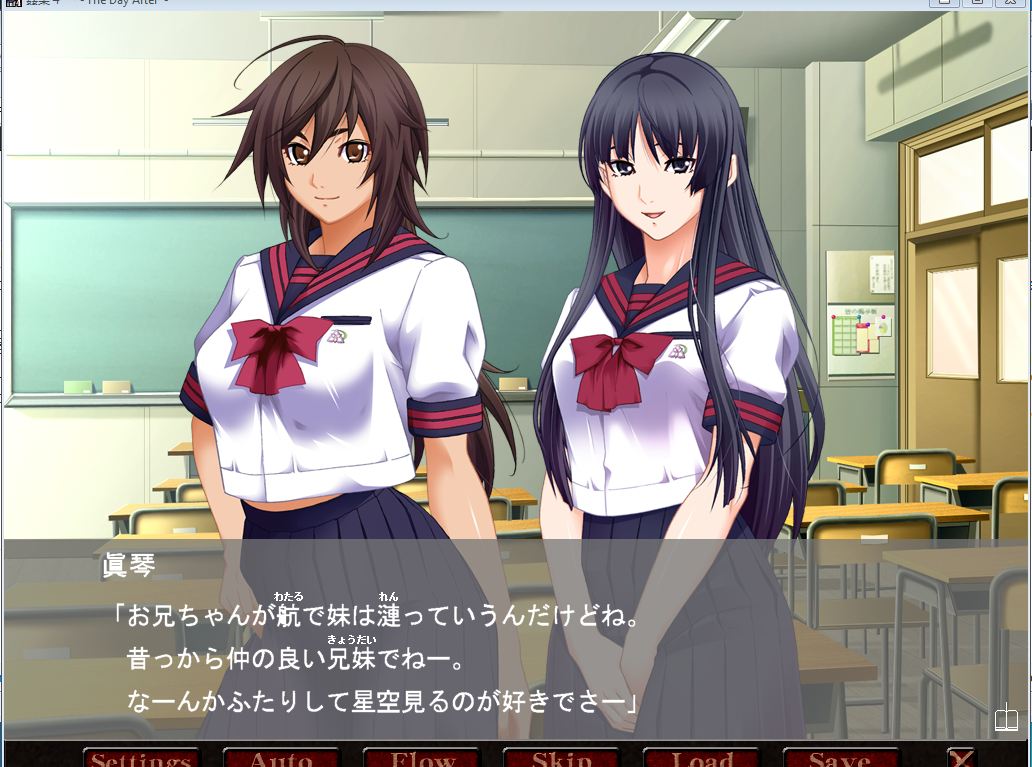
story of love and zombies, I figured that I’d follow suit and present to
you a review of Speed’s fourth entry into its zombie eroge series Kansen 4 ~The
Day After~, released April 30, 2010. Considering how much I enjoyed the third
game, I was eager to try out the next one despite warnings from a few fellow
members of the fanbase that it wouldn’t be as good. Thanks to those warnings I
was able to keep my expectations to a minimum, and one playthrough later…well,
I can at least say it’s better than Kansen 2.
Pros: Strong finale to the story, likable characters, story
has some nice nods to its predecessors, good voice acting, good artwork, uses
some new music and uses them well.
Cons: Most of the story feels a bit too standard for the
series, the false ending routes get a bit too much attention than needed, Kozue
is pretty lacking as a heroine, the return of those God awful time limit
choices!!!
WTF?!: It’s always funny to see how some eroge companies put
self-product placement into their games.
Kansen
4 starts at about the same time as the first game with the main story occurring
the day after its events. Just before
the virus breaks out, Daisuke Sendou and his group of friends decide to go on a
camping trip just before the summer break ends. Because of the distance of the
camp grounds from the city, they unknowingly escape the initial outbreak, but
at the same time are completely unaware of it until the hordes of the infected
make their way out of the city…
Okay,
I’m going to have to start with what I feel is one of the biggest flaws that
Kansen 4 has concerning its story. It’s not bad by any means, but from when the
zombies show up until the final act the game’s story just feels too standard
for the series. We have the arrival of the zombies basically signifying the end
of Daisuke and co.’s normal peaceful life, Daisuke is the natural leader of the
group from the start in the face of this crisis like Yasuyuki and Hiroshi, Daisuke
and co. flee the zombies and over the course of this he gets closer with the
heroines…it just feels like the writers were playing it safe compared to how
Kansen 3 did things a bit different from its predecessors. Now I realize that
Kansen 3 was probably made to bring fans back after its sadly subpar prequel,
and I can understand wanting to play it safe so as not to lose those fans again,
but at the same doing this almost robs Kansen 4 of an identity of its own
amongst the other games of the series.
To its
credit though, Kansen 4 does a good enough job getting things started. While
the prologue to establish the characters is a little on the longside, it does a good job introducing the
central cast and establishing them as a group of friends. A good example would
be Aya’s arc of her befriending Daisuke and co. at the beginning of the game as
it not only helps in giving the prologue some heart but also provides an
additional feeling of the loss of normalcy with the outbreak since that also
means the end of the days of having a normal social life with the friends she’d
just started to make. The prologue also does a good job at giving nods to both
the first and third game, the latter of which actually making for a nice little
tie in to Wataru and Rin’s background that was only talked about in the third
game.
Before
I get to where this game truly excels, I should mention one more story element
that I only kind of consider a flaw but it’s a tad off-putting all the same. Basically
the false ending routes seem to have gotten a bit too much attention than
needed from the game’s writer. Don’t get me wrong, giving the fake/bad ending
routes some story isn’t a bad thing; I don’t even mind that in some cases we
find out a little extra about some of the characters in them. The thing is none
of these routes prove to be of any real significance to the real story of the
game (which pretty much retcons most of what occurs in those routes anyway),
give no real incentive to see them aside from the ero scenes since the
character info is pretty minor and implied anyway in the main route, and in the
end only come off as filler. I feel that if you’re going to give those kinds of
endings story, then they should either reveal something significant to the main
plot (like 999) or provide some kind of incentive to see them besides just ero
scenes (like the Tiger Dojo of Fate/Stay Night or the quest system of Rewrite).
That
out of the way, I can now talk about what I feel is the strongest point in
Kansen 4’s story, what not only finally gives the story an identity but also
has me glad I sat through and played to the end: the finale. Now I know how
that sounds at first, like if you’d ask me how this game was and my answer
would be “Well…I liked the end of it”, but there’s a bit more to it than that.
First, the way that the finale is written (regardless of the route you’re on)
makes for an interesting contrast to Kansen 3 in that while the third game
ended on a triumphant note this game’s ending is more bittersweet, having it
match tones with the first and second games endings which do make sense for an
aftermath of this first outbreak. Kansen 4 does manage to distinguish itself
from its predecessors in this area, though, by being able to pull off an
effective bittersweet ending without having to fall back on the way overused “only
two survivors at the end” trope that so many horror stories often do.
The
second thing that makes the finale so strong comes from how well Aya and Makoto’s
routes turn out either as a result of or in connection with that. While the
relationship building between both heroines and Daisuke is handled well and
made believable over the course of the story, be it Aya’s opening up to her new
friends that ends up resulting in a slightly stronger connection between her
and Daisuke or how the events of the outbreak and Daisuke’s leadership have
inadvertently gotten Makoto‘s feelings towards him to be more than just friends,
it’s the finale’s bittersweet tone that helps to give the end of both routes
more feeling than any of its predecessors’ and that says a lot considering how
good all three games main finales are (yes, even the second game had that in at
least Maya’s good ending). The outcomes of Aya and Makoto’s routes I find are a
good representation of an answer to the question “What do you do in the
aftermath of a life shattering tragedy?”. Do you move on and start things over
completely anew or do you pick up the pieces of whatever is left and try to
rebuild from there? Since neither answer can really be considered wrong and
both endings do such a good job portraying those situations, Aya and Makoto’s
routes are at a deadlocked tie for my favorite route for this game.
Sadly
this also brings me to the final major story flaw of Kansen 4, Kozue’s route.
Now don’t get me wrong, I don’t hate the character, it’s just that her role in
the game’s story really has problems. While the prologue does a good job in
establishing her in Daisuke’s circle of friends, there’s no getting around the
fact that she’s a blatant clone of Rin from Kansen 3 (if you’re wondering why I
haven’t praised Kansen 4 for finally not cloning Yu again, here’s why) both in
terms of her relationship with Daisuke and some aspects of her personality
(heck, she’s even voiced by the same voice actress). Of course “some aspects”
is the key word here since Kozue sadly did not get any of what made Rin such a
good heroine in the previous game. You know that one member of the group of
characters in a horror movie that, when the killer or monster(s) show up, half
their dialogue from then on is screaming and the other half is complaining?
That’s basically Kozue for most of the game after the zombies show up, and as
you can expect she contributes very little to the story as a result whereas Rin,
despite being scared by the events of the outbreak herself, pulled what weight
she could in a supportive fashion such as helping prepare the group’s food and
she had the additional disadvantage of being sickly. Kozue’s limited involvement
in the story also really hurts the relationship development between her and
Daisuke since by the end you can only see the relationship as more plausible
than believable since their getting together at the end doesn’t really feel
earned like the other two routes. It also doesn’t help that the route’s end
scene is rather short compared to Aya and Makoto’s routes, and it really has me
wondering if the creative team either ran out of time or simply didn’t know
what to do with the route.
Moving
on to the technical aspects of the game, I can say that Kansen 4 does not have
as many bugs as its predecessor, though the game can crash if you click on the
game window immediately after you run it. While I do think the game window is a
little too big (and sadly you can’t adjust its size), the only real flaw is the
return of the timed choices and like in Kansen 3 if you mess it up and haven’t
saved in a while it’s time to retread your steps. I’ve already ranted about
what I think about the timed choices in this series so you all should know how
I feel about them and why I consider them a negative. To Kansen 4’s credit
though, there are less timed choices than in the previous games so it’s not
quite as annoying as before.
In the
area of presentation Kansen 4 does as good as always with good artwork all
around (though some of the zombies do dress a little funny).The voice acting is
all good, and the music takes a another step forward by giving up the old ending
theme entirely and giving us a new one that actually really helps in setting
the atmosphere for the finale.
As for
the ero scenes, once again they’re all good, be they the romance ones or the
zombie related ones, whichever you prefer.
Character Profiles:
Daisuke Sendou:
A student and part time mechanic at the auto repair shop
owned by Makoto’s father, Daisuke has a love of motor bikes and has hopes to
turn that into a career after graduating.
Aya Masaka:
One of Daisuke’s classmates, Aya is an excellent student
with refined air about her. Doesn’t seem to have any friends or interact much
with the other students, though it’s unclear whether it’s because she’s
antisocial or just shy.
Makoto Abumi:
Daisuke’s classmate and friend, Makoto has an outgoing and
tomboyish personality which actually helps her get along well with both boys
and girls alike.Because Daisuke works
at her father’s repair shop where she also works, and because the two have
similar interests in the field of mechanics, Makoto and Daisuke meet and hang
out frequently.
Kozue Notoya:
Daisuke’s neighbor and childhood friend, Kozue usually hangs
out with both him and Makoto, especially since she sees Daisuke as an older
brother figure. While she normally has a bright personality around her friends,
Kozue does at times show a timid side that may hint at her not reacting well to
stressful situations.
Sho Ishigoka:
Daisuke’s upper classman and childhood friend.
Saeko Kirikoshi:
Sho’s girlfriend.
In Conclusion:
Kansen
4 is a good but flawed entry into the Kansen series; while it doesn’t really do
that much wrong aside from messing up with putting Kozue into the story and
focusing a little too much on the false routes than needed, it doesn’t bring
anything new to the table either. The strong finale does at least make up for
that and makes the game memorable enough that I’d recommend this to anyone who likes
the series. Just don’t go in expecting this to top the third game, and I don’t
think you’ll be disappointed.