Monday, April 13, 2015

Games for Adults and Everyone: Cho Dengeki Stryker


Cho Dengeki Stryker Review

                Well with Avengers: Age of Ultron’s cinematic debut around the corner, what better a way to celebrate that than a look at the best (and to my knowledge only) superhero VN commercially available in English? Originally released as Dengeki Stryker in Japan on June 24, 2011 by Overdrive and an almost year later English release by Mangagamer June 22, 2012, the game would get an expanded Japanese version (hence the ‘Cho’ name) on July 27, 2012 which was released in English on March 28, 2014. This localized release came in quite a few options: an expansion patch for those who bought the original release, a full digital release for newcomers, an all ages release on Steam and a physical version.  Obviously MG did all it could to make sure as many people as possible could play this game and the fact that I’m covering this in anticipation of Age of Ultron means I find Cho Dengeki Stryker good, but please allow me to elaborate…


Pros:  Excellent stories, great characters, excellent art work and animation, top line voice acting, awesome soundtrack.
Cons: Zero Saga is a bit weak, Hilko’s route is a little on the short side, villains are just okay.
WTF?!: Yes, one of the semi-major characters is a talking dog (who can also fly and breath fire), and that’s awesome.


                Cho Dengeki Stryker’s story begins with an innocent childhood wish by a boy, Yuuki Yamato, after he fails at protecting his childhood friend Haruna from a group of bullies. This wish is to become the superhero he idolizes: Dengeki Stryker, and as it happens Yamato encounters a mysterious old man who calls himself the Memory Collector who grants the wish in exchange for Yamato’s memories. Years later a strange group of people with super powers appear with the intention of conquering Japan in the name of the Balbora Empire, but a lone hero stands in their way. A hero who bears a strong resemblance to Dengeki Stryker…

                When it comes to the plot Cho Dengeki Stryker does a great deal right. First and foremost it tells a good superhero story that fully embraces many of the tropes of the genre be it from the kind we see in anime and manga to those seen in comics and movies (and even a little sentai) and does a great job in demonstrating why they work so well. The scenes where Yamato and many of the other characters do something heroic always carry the right emotional weight to feel genuine and often awesome.  CDS also takes a good look at some of those trope be they comedic, such as the ridiculous effectiveness of a change of clothes, or something more in depth like a look at the concept of identity in relation to that of our hero. Best of all the view the writing has regarding this superhero story, heroism and what good can come of it is an overall positive one, but a well-balanced one too. It’s not afraid of venturing into dark territory at the right story points, yet it meets it with the right amount of heart backed up by good writing that keeps it from descending into the pit of world weary cynicism some hero stories might go to.

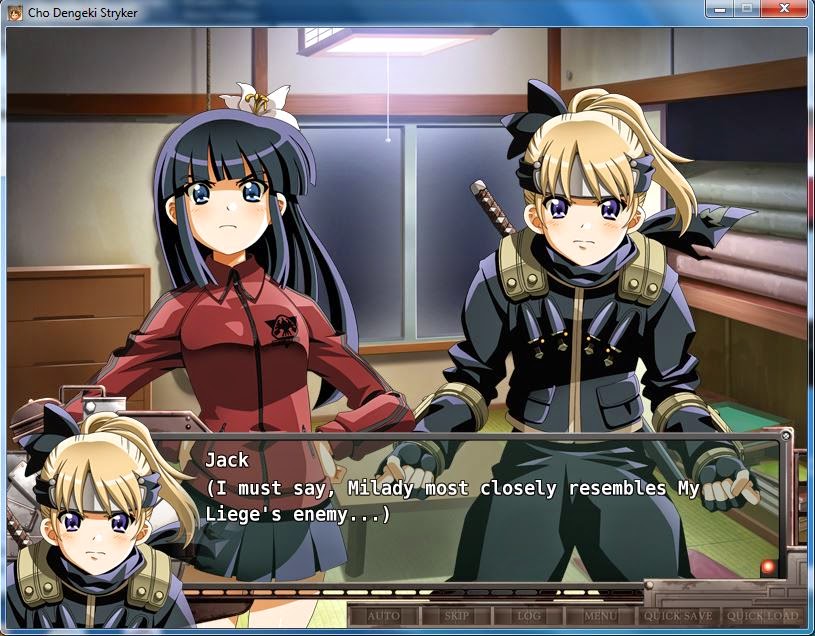
                Second of all the story has an excellent cast of characters who are just as, if not more, appealing as the plot is (click here for profiles). Yamato himself makes for a good protagonist with his altruistic personality fitting for a hero yet also hilariously sticking out when in a normal environment in a way very reminiscent of Full Metal Panic!’s Sousuke Sagara. His partner Jack the Texan ninja (sadly a rarity here in Texas) makes for a great sidekick by bringing an even higher level of strangeness into the mix, enough to make the already unusual Yamato the straight man in many of their scenes. Of course in the area of character humor the characters that have the lion’s share of good scenes are the Balboran Vanguard from their group dynamic with one another to the contrast of how friendly they are with Yamato outside of battle since neither one knows the others’ secret identities. These scenes do a really good job in getting you attached to these characters and get invested in their fates in each of the story sagas and even the character development some of them go through.

                Naturally the heroines of CDS are really good too. While Haruna does come off as your typical (non-tsundere) childhood friend type heroine at first she’s written well enough to be likable and then gets better as the sagas give her some good character moments later on. Sayaka brings quite possibly the best chemistry with Yamato by essentially being the Kaname Chidori to the aforementioned Sousuke Sagara analogy of our hero when it comes to his odd but well-meant antics. It’s also helped that her backstory is interesting and connects well to the plot of her saga. The new heroines of the Cho content are also really good, but I feel I should explain a couple things first.

                Normally this is where I’d do a route ranking but the thing is Cho Dengeki Stryker kind of has a route structure but also kind of doesn’t. The stories this game has to tell are divided into six “sagas” (plus what’s essentially the common route):  Zero, Heaven, Sky, Love, Steel and Light. In the original Dengeki Stryker release it was just Zero, Heaven and Sky. The Zero saga is essentially  the introduction story and is kind of Haruna’s route; it basically introduces the main concept of the story as well as story elements that are further explored (and approached differently) in the next saga, Heaven. Heaven saga is a different continuity than Zero being Sayaka’s route and Sky acts as an epilogue/true ending that wraps up all the story elements there. Now of these two initial continuities Heaven-Sky is unquestionably stronger due to its being longer and having a much better ending while Zero has trouble standing on its own due to a weaker ending  and quite a few plot holes thanks to the reveals in Heaven-Sky. Before the release of Cho it was assumed Zero saga was essentially retconned by Heaven-Sky, but thankfully this expansion fixes the former saga for the most part.

                Obviously the new sagas were Love, Steel and Light. The Love saga is Hilko’s route and is more character focused and has less action than the other sagas. I found it entertaining since it brought in more character dynamic from the Balboran Vanguard and giving more insight into Hilko’s character than we see in the other sagas was interesting and had some payoff in seeing how she is when she genuinely cares for another person. The only problem the Love saga has is it’s basically a side story compared to the others thanks in part to it being comparatively shorter and the ending comes off as a bit too hasty a wrap up and its ignoring some major story elements from the other sagas is a tad off putting even though I know it’s supposed to be a side story.

                The Steel and Light sagas are continuations of the Zero saga and like Heaven-Sky the former is the main story and the latter is the epilogue/true ending. This storyline does a good deal right in taking on the monumental task of fixing what was the weakest saga in the original release. The all new heroine it introduces, Clie, makes for a welcome addition to the game’s cast being both a likable character and providing her own brand of humor that makes for a good play on Yamato’s altruistic personality, especially with the context of how he’s developed since the events of the Zero saga.  It also helps that of the heroines she’s the most badass and perhaps one of the few flaws of this saga pair is we don’t get to see as much of her in action in the latter saga. This saga also does a good job developing Rin as a character too as it gives her as much character focus as Clie so it’s technically a shared route for them, though the only difference in which of the two Yamato spends more time with is a couple of scenes. 

                So basically we have two main continuities: Heaven-Sky and Zero-Steel-Light. The former offers a traditional story of heroes while the latter focuses a tad more on world building than that. Of the two it’s a tough decision but I’d say I favor Heaven-Sky a little more since I find it to be a stronger conclusion while Zero-Steel-Light leaves a couple minor things up in the air and a big dramatic scene is a bit confounded by my wondering “wait, why didn’t they just…?” at a couple parts of it. Other than that I can say both continuities lead to overall satisfying conclusions and are well worth reading.
                As for any other flaws concerning plot, the only major one is the villains are just okay. I’m not talking about the Vanguard as I don’t consider them villains, but some characters that show up later. While not annoying or anything like that (though I will admit one of them does toe the line at being too invincible) there’s no real depth to these characters and really have no remarkable traits aside from being the quintessential final boss for the heroes to defeat (though I suppose you could argue Zero saga’s villain as an exception). Not that there’s anything wrong with those kind of characters, it’s just that when all the other major characters are so good they stick out like a sore thumb in comparison.

                In the area of presentation Cho Dengeki Stryker hits it out of the ball park on every front. The artwork is excellent with each character having their own unique look, the CG perfectly capture the action of the scene they illustrate and look like a good screen shot from an anime and so much of the design harkens back to the anime/manga designs of the 90s that were greatly inspired by the 80s anime/manga. That was probably intentional considering the vocalist for the game’s opening themes is Masaaki Endoh whose done vocals for several anime, one of the most well known being The King of Braves GaoGaiGar/Yuusha Ou GaoGaiGar which CDS does seem to draw some design inspiration from. The rest of the music is also really good in how well each tune captures the mood of their respective scenes, and furthermore in the sound department the voice acting is top notch with the vocal talent including Megumi Ogata who I’m sure many recognize as the voice of Shinji from Evangelion, Yugi from Yu-Gi-Oh!, Cookie from the Majikoi games and Kurama from Yu Yu Hakusho to name a few. Finally the animated scenes are directed by Shinichi Watanabe director of anime like Excel Saga and Tenchi Muyo! GXP and also did work on the aforementioned GaoGaiGar and while these scenes may be reserved for the beginning and end portions of the game they’re a great site to behold and honestly has me wishing for a full on anime for this game (provided it’s a good adaptation of course).
                As for the ero scenes, assuming you decide to get the adult version, they’re…okay. Haruna, Sayaka, and Hilko have theirs occur at a fitting late point in their routes and the first two also get an extra one each that you can access from the extras menu after clearing said routes and all of them are fine as ero scenes. Rin and Clie’s are unlocked after clearing the Steel saga after making the choices on which of the two to focus on respectively but their scenes are…odd. In Rin’s case it reads like a second or third ero scene as it references a previous scene we never see, while Clie’s is just strange and I’m not exactly sure what the writer had in mind when writing it. The overall thing is the scenes don’t really have much plot importance which I’m sure is why an all ages release was possible.

In Conclusion:
                Cho Dengeki Stryker is a visual novel game that is well worth experiencing. It’s an excellent superhero story filled with enjoyable characters supported by great artwork, a phenomenal soundtrack with vocals from Masaaki Endoh, grade A voice acting and well implemented anime scenes directed by Nabeshin himself (sorry no cameos as far as I could find). While the game has its flaws they’re overall minor ones and barely detract at all from the experience. In this entertainment era of superheroes I can declare with certainty that Cho Dengeki Stryker is a story that should not be missed.

Final Score: 8/10 Awesome

Author Recommendation: Buy it now.

You can buy the regular digital release here, the hard copy here or here (warning NSFW images on those links) and the all ages Steam edition here.

Thursday, March 26, 2015

Games for Adults: Osananajimi wa Daitouryou: My Girlfriend is the President


Osananajimi wa Daitouryou: My Girlfriend is the President Review

                Regardless of your political views there’s no denying the campaign of current US President Barack Obama was an interesting spectacle to watch. From the sudden magnetism of the candidate to the marketability of the guy’s image (which could sometimes become downright bizarre), even a lot of the most politically apathetic at least took some notice of it all. Not surprisingly this was noticed internationally too and somehow this inspired Alcot to create Osananajimi wa Daitouryou: My Girlfriend is the President (called Osadai for short), released in Japan October 30, 2009 and later released officially in English (through the help of a fan translation group’s work) by JAST USA December 26, 2011. This game got the attention of the western VN community not only for its “moe” take on Obama (though that’s really just in the name) and Vladmir Putin (which with current world events context make this even funnier), but also for it’s odd but amusing (and somehow well English dubbed) trailer. All in all, this looked like the perfect bundle of Japanese weirdness that we otaku have come to love, but the question is whether it managed to pull it off well.

Pros: Laugh out loud funny comedy, main cast of characters are likable, excellent artwork and effects, very good music, great voice acting.
Cons: Remi, main villain should have been more over the top, Irina’s route is pretty weak.
WTF?!: This is our main villain, an alien modeled after former Pope Benedict XVI with a name similar to a very infamous German. Never has the phrase “Oh my God” been a more fitting reaction to the strange things I've come across in VNs.


                 You play as Junichiro Hondo who at first glance would be your typical laid back skirt chasing student with a devoted childhood friend who lives next door that you’d find in many an eroge. The thing is his childhood friend, Yukino… You know what, there’s no way I can give a summary that does this game’s wackiness justice so just check out the aforementioned trailer.

                As you can see Osadai is a game that revels in its silliness and for the most part succeeds in getting its readers to laugh. The jokes mainly range from your typical pervert protagonist antics to references to anime, games and movies. Thanks to good writing and presentation these jokes not only manage to be funny despite the cliché of the former and the potential dated-ness of the latter. That isn’t to say that’s all the jokes as there’s some laughs to be had from many of the character interactions and the humor of the random bizarre variety. Nothing best exemplifies that than the talking bespectacled space faring panda.

                Speaking of the characters (click here for profiles), Osadai does a good job giving us likable main characters to follow around.  Junichiro makes for good protagonist and each heroine has their own unique personality and fitting brand of humor to bring to the table whether as being the observer, target of or instigator of the many humorous scenes throughout the game. We also have good supporting characters in Junichiro’s friend Morita, Irina’s maid Kuon, and the (sadly unwinnable) wacky alien (and occasional fourth wall breaker) Qoo and not only do they provide some very  funny scenes  but each of them has at least a good character moment in one of the routes.
                Sadly not all of the characters in Osadai as enjoyable the aforementioned and this is where we get to what may be the game’s most glaring flaw: its villains kind of suck. First and foremost, remember the subject of the WTF?! for this game? Well I’m sorry to say that aside from the novelty of his appearance and name the game doesn’t do much beyond standard with this character in regards to villainy; he basically just acts like a standard foil when the story requires it which makes the character range from bland to annoying. If you’re going to make your main villain look like the (at the time) Pope and name him after a Nazi you’d better make the most of that and go so over the top with this character  you’d hit the moon. The VA should be hamming it up in almost every scene and the character should do stuff like fly around in Dr. Wiley style rendition of the Pope-mobile that fires spinning razor sharp crosses while he throws vials of holy water that’s actually acid (heck there you’d have the benefit of a Castlevania joke/reference). Basically in a good comedy your main villain should be at least as funny as all the other characters.

                 Unfortunately on the villain front Osadai doesn’t just suffer from a bland main villain, but also an extremely annoying sub-villain named Remi. What we get from this is a character whose main character trait is to show up and then insult and bother anyone who isn’t Yukino. That may not sound like much, but after seeing it in 90 percent (and I think I’m being generous there) of the scenes she’s in it gets old really fast, especially if the first route you play is Yukino’s. In that route Remi’s annoying traits get amplified as she’s essentially given a role that is one of my most hated tropes: the heroine’s annoying/interfering friend. Trust me I could go on a long rant about why I hate said trope with a passion but that’s for another day. Suffice to say one reason I hate it is because it’s just  a plot device to pad the story with essentially the same scene over and over until the author decides they’re ready for the plot concerning the hero and heroine’s relationship to advance and while in this case it thankfully doesn’t last long it certainly feels more than long enough. I know Remi’s supposed to be a villain and these scenes are probably supposed to make me dislike her, but a good writer should not make scenes with their villains a chore to sit through and especially not make me have to retreat into a mental “happy place” to get through the character’s scenes. And in case anyone’s curious in this case it was imagining Remi on the receiving end of what another mechanical villain gets.

                In regards to the routes here’s my rankings:
1)      Tie between Yukino and Ell
2)      Ran
3)      Irina


                The reason Yukino and Ell’s route tie is mainly because both heroines just really click with Junichiro in their own unique way. While Yukino does pretty much fall into a majority of the childhood friend type heroine tropes the game’s writing presents it in a way that keeps it from feeling stale or annoying and kind of shows why this trope has remained so prominent. I couldn’t help but find Junichiro’s interactions with Yukino cute as well as funny and considering it’s enough to cure the bad taste Remi’s role leaves once she’s kicked out of the plot is saying something. In Ell’s case not only do we have cute and funny scenes with her too, but also an interesting backstory that ties in well with the game’s story and also sets the ground for a good character arc. It also helps that in this route Remi takes the most abuse. The only reason it doesn’t beat Yukino’s route is the route is shorter by comparison and I admit the ending is a little predictable.

                Ran’s route I liked mainly not just because Ran herself proves to be a good character with some nice chemistry with Junichiro but also with how crazy it gets in bringing focus to the aforementioned panda and it only gets sillier from there. This makes for a good demonstration of how far the game can go in seemingly random humor and pull it off. The route even succeeds in giving Remi a good character moment late in the story which actually had me wanting to see more from her in the plot. That sadly brings me to the route’s fatal flaw: unlike Ell’s which while on the short side still felt like about the right length Ran’s route is on the short side and its noticeable. 

                Now we’ve reached Irina’s route and I am sorry I have to put it in last place. Having played Yukino’s route first I was really looking forward to what Irina’s would have in store seeing as how enjoyable a character she was in that route, not to mention a lot of the people who played the game either through import or a fan translation patch gave both the character and her route a ton of praise. Unfortunately this route left me bewildered at the praise instead in the end. Don’t get the wrong idea though, I won’t say Irina’s route is terrible just really weak. This route does have some good character moments and laughs with her plus she and Junichiro have good moments together too, but all that is offset by two major problems on the writing front.

                The first problem rears its head almost as soon as the route starts: an extremely slow first act. Basically the route goes in a direction that I’m sure was meant to build Irina some more as a character  while also building up the romance that’s supposed to occur between her and Junichiro. The problem is the writer seems to have forgotten you need to make scenes like these interesting in order to properly character build. Instead we get scenes that feel like filler at best to just plain boring at worst. The best example would be this one scene where we’re to learn about Irina’s hobby of Judo, but rather than anything interesting where learn about the character we instead get a boring presentation from her about the martial art. Just take a look at the picture below and you’ll see:

                Now I understand that might have been intentional considering the outcome of that particular part of the route’s story, but that actually brings us to the next problem this route has. The problem is out of all the routes in this game, Irina’s is the only one that seems to be taking things at least half seriously. Bear in mind I’m not faulting this route’s writing for trying to be different, I’m faulting it for trying to be different and failing. For example that bit with the Judo I was talking about, its attempt to be serious just results in awkwardness on the level of a bad episode of The Simpson where the writers decide to be serious about something. At the end you’re just glad it’s over and are hoping it’ll get back to being funny next time. That isn’t to say every serious scene in this route is bad; there are some quieter moments between Irina and Junichiro which do well on the drama end while feeling like a natural part of the story.  It just would have been a lot nicer if the other scenes had that kind of quality.

                In the area of presentation Osadai succeeds in every aspect. The artwork is excellent from the character designed to the many CG it uses, many of them for the more over the top comical scenes. There’s actually a manga inspired presentation for all of these with the character dialogue appearing in speech bubbles rather than the traditional text box (which is reserved for narration) and the aforementioned comical CG not only has a manga panel look to it, but some of them are even drawn to parody some specific series . There are even some effects for the character portraits that do a good job in conveying the characters’ reactions too. The music is good and the voice acting is excellent, a good example being from Ell’s VA Miru who does a voice different enough from her usual that one may not recognize her at first.
                As for the ero scenes, they’re all good but there’s a bit of an unfair balance where Yukino and Irina each get three while Ell and Ran only get two.

In Conclusion:
                Osananajimi wa Daitouryou: My Girlfriend is the President is an all-around entertaining game with hilarious comedy and a likable cast of core characters. While it does have some issues like not very well written villains and the second main heroine’s route is (to me) the weakest I still say it’s well worth your time and money if you want something light hearted and funny. You can find a copy here (this one is cheaper) or here.

Final Score: 7/10 Great
Author Recommendation: Buy it now.

Saturday, February 14, 2015

Games for Adults: Eroge! ~Sex and Games Make Sexy Games~


Eroge! ~Sex and Games Make Sexy Games~ Review

                I’ll admit I’m a little late in reviewing this, but seeing as it’s Valentine’s Day it’s now time for me to give my thoughts on CLOCKUP’s Eroge! ~Sex and Games Make Sexy Games/ H mo Game mo Kaihatsu Zanmai~, released in English by Mangagamer on September 13, 2013. Some of you may have read my impression of the demo…I was less than impressed and much less enthusiastic about playing the finished product. Now that I have…I can say I know when to admit being wrong (for the most part).

Pros: Pretty good story, characters are likable once you get past where the demo ends, good music and voice acting, good artwork.
Cons:  The start of the game, the beginning portions of Momoka’s route, unwinnable heroines.


                In Eroge! you play as Tomoya Mochizuki, an avid eroge player who wants to enter the eroge industry. Unfortunately for Tomoya he has not been able to find any work with any of the companies as he doesn’t really have any game making skills. His chance seems to come when he’s able to land a job at an eroge company called Flower…until it’s revealed that said company is facing going out of business unless their next game sells well. Upon discovering the problem lies with how each of the girls in charge of making the games is talented in their field but not very good at applying it to making eroge, it’s up to Tomoya to use his vast knowledge of the genre to help ensure a good game is made.
                While I’d like to get to the positives first, there’s no way of getting around it, the beginning of this game is kind of a chore to get through. I’ll admit I’ve never been a fan of the trope of the main character being treated like crap by the heroines at the start of the story be it in an anime/manga or game as it often makes character introductions a chore as it makes said characters unlikable and often uninteresting.  Fortunately this isn’t for a long period and the story gets better but if there’s a part of the game that shouldn’t feel like a chore to complete, it’s the introduction.
                Once you get to the main story Eroge! becomes a more enjoyable read; the heroines start showing interesting character traits, you get your obligatory ero scenes, and we start getting a look at how an eroge company working on a new game.  The last of those is perhaps the most interesting aspect of the story for a couple of reasons: first seeing an accurate enough (according to people who are familiar with the eroge industry) look at the process of making an eroge was interesting to see in how it matched in many ways with the details many indie game companies leave in posts on their websites or blogs. The writing approach does a good job presenting the process and the many trials and tribulations an eroge company could face in a way that’s easy to understand and its often light hearted look at the problems that can crop up during each phase of gaming is a good way to inform and entertain at the same time.

Second, and certainly what helps pull this game’s story up from its weak beginning, is the story’s sincere love for this niche game genre it’s built around. Interwoven in all the jokes and ero scenes is an honest look and nod of respect towards to the elements necessary to make a good eroge and the people who work hard to make those elements work together.  While I’ll admit at times Tomoya’s enthusiasm  for the genre seems a little much (then again this is during more comedic scenes), the fact that his story ultimately got me to think a little on eroge and why I like it is a notable accomplishment. Perhaps best of all each story’s route does a good job in portraying how good it would be to have someone to share that love of the genre with.

Now for the route rankings:
1)      Kisara
2)      Iori
3)      Momoka
4)      Nene


            I’ll admit after playing the demo I would have bet any amount of money against Kisara being my top pick but count this as one of the (good) curveballs life can throw your expectations . Kisara’s route wins out because out of all of them it has the best written story. Her relationship with Tomoya has a good arc and the dramatic part of her route actually did a good job getting me to care about its outcome.  On a side note, it’s an interesting coincidence that the problem Kisara has to deal with resonates quite well with some gaming related controversies that have come up recently. It also helps that part of its resolution involves a scene with Iori where her VA, Mio Okawa, really shows her voice acting talent by pulling off a convincing dramatic scene with a character far more subdued than her more well-known role as Bachou in the Koihime Musou series.
           Speaking of which Iori takes second place mainly because her route is more simple than Kisara’s, not really having a dramatic turn to it. Still the route’s story plays its strengths well by portraying a strangely interesting relationship that develops between her and Tomoya that results in a pairing that goes to interesting and amusing lengths in the kinky department but at the same time are believable as a couple. I must say both Okawa-san and the writer deserve commendation in this, the former for owning this role when compared to her previous roles and the writer for being able to portray the romance in a way that feels natural to both characters without having to go over dramatic about it.

            Momoka’s route came as another surprise as until I played Iori’s route (which I did last) hers was in second place. I fully expected her route to suck and for a while I thought I was right. Ultimately that’s why the route is in third place because the first quarter or so of it is unquestionably terrible. During that time you have to put up with our heroine being downright insufferable; I myself was gritting my teeth grumbling curses as I was formulating how I was going to roast this route as quite possibly one of the worst routes I’d ever had the misfortune to play…and then the story makes a change for the better. Basically something happens that makes Momoka’s personality do a bit of a 180, and while the circumstances for it may raise some eyebrows the fact that it makes the route readable makes up for it, not to mention the brief dramatic fallout from it was good enough. Basically from there we finally get to see some surprisingly good chemistry between the two and from there I enjoyed the route all the way to the end. I just wish the beginning wasn’t such a mental trudge to get through.
            Nene’s route ranks at the bottom because while not a bad route as it does have good scenes be they her interactions with Tomoya and several scenes of her working to become more of a leader for the struggling eroge company than its de facto mascot, it’s overall the weakest of the bunch. The main reason is because the route’s story, especially the dramatic part of it, feels like a weaker version of Kisara’s route. While that route’s conflict worked because it was more character focused in how it depended on Kisara’s reaction to it based on what’s been established of her as a character and how that affects those close to her, in this route we don’t really get that since the conflict is entirely dependent on a villain character that only appears in this route and is as annoyingly featured into the plot as you could expect. While I get why this character is there to act as a plot device to demonstrate Nene’s character development, I can’t help but feel the writers could have come up with something more interesting to demonstrate that than introducing a character that reads like a rejected character for a South Park episode.
          There is one more flaw in the story department for Eroge! and once again it’s unwinnable heroines. Basically there are four sub-heroines (technically) who help out the core cast, and while there is certainly potential for a route it’s actually a trick element to the game as at a certain point in each route you can have Tomoya cheat on the heroine for the route with one of these sub-heroines which will result in a bad ending. While I admit it’s a clever idea, I can’t help but wish these characters could receive a full on route.
           In the technical area, Eroge! is your standard VN, though in the settings one can make some adjustments to the ero scenes to make some of the “kinkier” scenes stay within the player’s comfort level.
          In the area of presentation the game does well enough. The artwork is good, the voice acting is great and the music is fine, though I do question the need for so many variants of a single theme.
As for the ero scenes, they’re all good and I can say each heroine has something different to offer in the H department so I suppose you could say that enhances the replay value.  Should also mention that perhaps another enjoyable aspect of Kisara’s route is she has some of the funniest ero scene dialogue I’ve ever read in an eroge. I wish I could show you a sample but it’s something you should see for yourselves…and since I want to keep the blog safe for work in the images department…

In Conclusion:
                Eroge!  ~Sex and Games Make Sexy Games~ is an enjoyable game fueled by a comedic yet ultimately respectful look at the genre and its game making process. While it does have the problem of a weak start and couple other writing issues here and there it’s far from enough to ruin the experience. If you want a romantic comedy that’s also heavy on the ero this Valentine’s Day (or any day) then this is certainly worth picking up. Also you have the option of buying it digitally or buying a physical copy.

Final Score: 7/10 Great
Author Recommendation: Buy it now.

                As for the anime, I can say that as an adaptation it’s pretty good and even has some unique scenes in the H department. My only real complaints are first, its handling of Momoka’s personality turn around are entirely comedic without the brief dramatic fallout. I just feel its exclusion makes the change in her relationship with Tomoya less effective. Second, I do wish Iori and Nene would get a little more focus since the OVAs mainly focus on Kisara and Momoka. Other than that it’s a good watch, though I recommend playing the game first.