Tuesday, October 4, 2016

Games for Adults Halloween: euphoria


Euphoria Review

                Happy October 2016, folks!!  Moving and new jobs may have reduced this year’s number of reviews but this Halloween tradition will not go way so easily, so let’s get started. A year ago I closed out Halloween with a look at the demo for Clock Up’s euphoria. Ever since I played the demo I knew I had a shoe in for this year’s series of reviews and while I was right I have to also say this game turned out to be very different from what I was expecting. Without any further delay, let’s take a look at what many consider to be Clock Up’s best game, release in Japan June 24, 2011 and released in English by Mangagamer November 27, 2015.

Game OP: https://vimeo.com/103621723
 
Pros: Interesting premise that takes on very interesting turns with each route, interesting characters, Natsuki, very good art, great voice acting, good music.
Cons: The premise is not for everyone, Rika is not for everyone, true route has some minor writing issues, design for unnamed characters.
WTF?!: One reason I like Natsuki, we have a similar taste in movies.


                The plot of euphoria begins with our protagonist, Keisuke Takatou, waking up to find himself and six women, all of whom he’s at least acquainted with, trapped in a strange white room. A mechanical voice then informs them that the reason for their entrapment is to participate in a game that is also their only hopes of getting out. The game’s rules are:

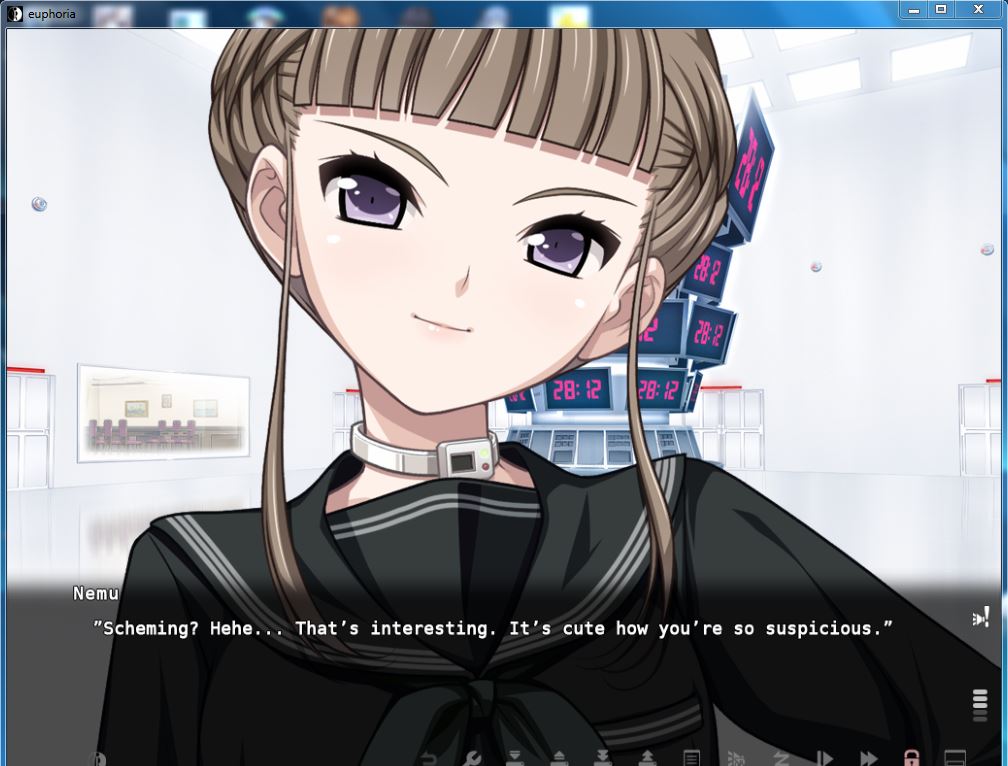
As outrageous as the rules sound naturally there are objections, but the group is soon given a very vivid demonstration of what happens to those who refuse to participate, making it clear participation is the only way to make it out alive. Yet as the group copes with this inescapable situation, Keisuke inwardly finds the idea of the game strangely appealing to his hidden sadistic urges, desires which he has long tried to suppress. One of the girls, Nemu Manaka, then approaches him and reveals she’s aware of his desires and wants to use this game as an opportunity to bring them out. Between surviving this game, the desire to protect his childhood friend and fellow game participant Kanae Hokari, and this, what fate awaits Keisuke and the others only time will tell…

                Okay, at first glance euphoria looks like the eroge equivalent of the Saw series. Heck, my demo impression used that idea as a lead in, and yet that’s only the tip of the iceberg.  While you do get that at first(and a bit more in some routes), at a certain point things change and over the course of reading each route it becomes apparent there’s more going on besides the game the characters have found themselves in.
                If there’s one thing euphoria excels at is how it’s able to get the routes prior to the true ending to lead into it effectively. To those unaware, one pet peeve I have with true endings is how if not done right (which can happen) it ends up coming off as retconning more interesting stories in favor of a less interesting story or main character/heroine  to focus on because it has more story revelation than the others. It comes off as the game telling you what to be invested in rather than you finding that yourself which breaks immersion. Thankfully euphoria avoids this by having each route work as a setup for the True Ending, and that’s going to take some explaining…
                Normally this would be I’d do a route ranking but of the four routes that precede the true one, only two of them can stand on their own as stories: Rika and Natsuki’s. This is because this pair of routes function as introductory stories that offer a good look at the game’s face value premise with brief glimpses at what’s beyond it. As such I would recommend playing at least one of them first and by that…well, it looks like we’re in for a (mini) route ranking after all…
1)      Natsuki
2)      Rika

                The reason Natsuki wins is for two reasons: first she and Keisuke have really good chemistry, arguably the best on the romantic front. Their conversations are interesting and even funny, plus they lead into some character info about Natsuki herself that honestly has me wanting at least another story with her as either a lead or main character. Second, the story I found to be pretty good too as it makes for a good way of starting to analyze the mystery around the game and through that get hints at what could be going on behind the scenes, enough for you to start making theories but only enough for that. Honestly if I were to do a route ranking that included the True Route, Natsuki’s would rank second for those reasons and because even taking into account what’s revealed in the True Route I think it can stand on its own as a “what if” story compared to the other routes.

                Now onto the subject of Rika’s route, this is the reason why I recommended reading “at least one” of this pair. That’s not to say this route is bad (I have played worse…far worse), in fact from a writing standpoint this route is probably the best to start with. Its function is basically to introduce the story’s premise and provide hints there’s more going on than at first and leave it at that with its ending, prompting you to play the other routes to find out more. The problem is Rika herself.
                The problem with having Rika’s route be the first you read depends on your tolerance for  flawed characters, because if it’s not high you may end up being turned off from this game. Now don’t get me wrong, I’m not using this as a “the masses just can’t appreciate flawed characters” kind of defense, since even from that angle I’ve read better. I’m saying that since that seems to be what the writer was going for (that includes commentaries). The thing is, as I indicated back in my demo impression, Rika is essentially written as that one character in the horror movie that has you wondering how long until the killer/monster gets them, and seeing as this is her route that means you’re going to have to spend a great deal of time with her and even I’ll admit that can be grating after a while.

                Ultimately if you decide to play or skip Rika’s route (which you can do since it’s not required to unlock the true route and you won’t miss anything critical to the overarching plot), I can at least say the character isn’t wholly without value. The game does some interesting things with her in other routes and I admit at the end of her route I was invested enough to see how it ended. Heck, the fact that I’ve written three whole paragraphs on this character means I got some kind of impression from her. On a final note on Rika, I believe I can point out on positive that I’m sure the majority can agree on. In keeping with Spoony’s assertion that the horror movie trope Rika falls into should be considered comedic, there is quite a bit of dark comedy gold in how over the top bad things go for Rika in the majority of her ero scenes.
                Moving along, we come to Rinne and Nemu’s routes, which may not be able to stand on their own as much as the previous two, but more than make up for that in their role of setting things up for the true route. Rinne’s introduces some interesting backstory information and goes in a very…unique direction that has the distinction of being penned by Banya Izumi, who some of you may recognize as the writer the majority of Black Cyc’s good games (like this one), Koichi’s route in NO, THANKYOU!!!, and one of our previous Halloween features: Dark Blue. All I can say further about this route is once you finish it try to remember your impression of the route then and consider it with what the true ending reveals. You may appreciate what it all means then, you may laugh, or you may feel like you need a shower…or all three.

                Now as for Nemu’s route…this one’s a little hard to explain without even hinting at potentially big spoilers but I’ll do my best. The key plot element here is what you would expect versus what you don’t expect. The route essentially goes along with what you’re expecting of it, but here and there tosses in moments where Keisuke briefly sees something very unusual before things suddenly go back to normal leaving you wondering what it could mean. These moments are few but are written in a way that indicates their importance to such extent that you feel as confounded as Keisuke when things finally come to a head and the route leaves you with more questions and how the true route can possibly answer them.
                This brings us to the True Route, aka Kanae’s route and boy is this a doozy to write about without setting off a veritable mine field of spoilers. While I could do a spoiler section like usual, I’m going to make an exception here because this route is something best experienced for yourselves. All I can say is the following: first, that aforementioned plot element from Nemu’s route of expected vs unexpected comes back, but in a different way than before. Second, the big reveal of the story is handled surprisingly well by taking something that sounds ridiculous but and not only building on it to make it effective  and natural, but also in making you want to go back and read at least some parts with a new perspective to see if there are any hints in disguise.
                With that praise though, I’m afraid I do have to point out some flaws euphoria has in the writing department. For starters while the routes do a good job  building up building up to the true route (and are at the very least interesting reads) there is the problem of the first arc of the game getting repetitive. Basically at that point the story segments that happens in between the scenes concerning the heroine you choose have very little difference and after two playthroughs you’re essentially left waiting until the text skipping is done so you can start reading something new. This even includes the end of the arc which is an exciting read the first time but only the first time since your previous choices really only change a few lines of dialogue (not counting the bad end choices).

                This brings us into the first of two flaws the true route has in the writing department, this one also concerning repetition. For story reasons, Nemu and Kanae’s routes follow a very similar plot line beyond the first arc. While this makes sense and leads into a good story payoff, it also means you’ll be skipping quite a bit of text for a while. Enough that you can get up, eat a snack and come back before the text skip reaches new story material. Considering this is the true route, having it take a while to get to anything new is a bit of a drag. It’s kind of like reading a really long and engrossing thriller and just as you’re about to find out the big reveal you lose your place in the book and now have to flip through almost every page just to get back.
                The second flaw, at least to me, concerns the ending. Don’t get the wrong idea, the ending is really good. In fact one bit of praise I can give is it didn’t end where I thought it would and manages to move forward from there without feeling like its dragging. The story goes along surprisingly well during that point and creates an interesting build up from some plot elements that time seem reminiscent of parts from the game NO, THANK YOU!!! which aside from the Izumi writing also shares a parent company and the same artist. The thing is I think the last few scenes are a little too short for what the story was building up. I can’t give any spoiler free details but I can say those few scenes could have used a little more length considering the content of the buildup and also to give the final scene more emotional effect.

                In the area of presentation, euphoria does very well. The artwork by Shigeo Hamashima is for the most part excellent, giving the characters good appearances and convincing expressions as well as giving the CG some good “detail”. The background CG is also well done, as it gives each major location the right impression such as the story’s game location with its largely white and clean appearance and how at odds yet at the same time strangely fitting it is as a setting for such a game. About the only case where the art weakens is later in the story where you see some scenes featuring other people besides the main cast. These are mostly nameless and voiceless characters and as such are given only the most basic character portrait but said portrait just doesn’t look very good and clashes with the better artwork we’ve been seeing up till then.

                In the area of sound, euphoria does really well on both fronts. With its music most of the scores are meant to generate atmosphere and do a good job establishing it, be it the mysterious nature of the series of white rooms the characters are trapped in and their seeming emptiness or the intensity of the scenes where Keisuke and co. are suddenly in peril. There are some more unique tracks for the really important story scenes, but describing what they invoke would be entering spoiler territory but I can say they do a good job in making the scenes feel as important as they’re written to be. Still, of the two the aspect of the sound department most notable is the voice acting.

                While our cast of heroines are the only ones voiced their voice actresses turn in such a good performance you hardly even notice this. Each actress does a superb job in bringing their characters to life from Nemu’s sadistic yet seductive nature offset by her more mysterious moments to hint she knows more than she’s letting on, Natsuki’s supportive and altruistic tendencies coupled with a strangely inquisitive side, to Rika’s self-centered behavior and how the story plays off that for her for better or worse. It’s helped that the actresses chosen for the roles are all really good ones such as Mei Misonoo as Natsuki, who some of you may recognize as Momoka from Eroge!, Nellis from Kyonyuu Fantasy Gaiden and onwards, and Nadine from Kyonyuu Fantasy 2 and if. Speaking of, similar to the aforementioned NO, THANK YOU!!! one unlockable extra that features here are commentaries  from those involved in the game’s creation, including the VAs. If on commentary is worth listening to it would be that of Konoha, Rika’s VA, as she has some very interesting and amusing things to say regarding how playing the role went, especially for one particular scene. This brings us right along to our next segment…
                We finally get to the ero scenes and this actually is going to take a little more talking about than simply saying if they’re good or not. First off, let’s dispel a little misconception one might get from the story summary and at face value attributing this game to Saw. While euphoria does feature ero scenes of the hardcore variety none of the scenes go into being straight up gory and bloody. If you’ve been looking at CG for this game then I should point out that (aside from shame on you for potentially spoiling yourself) that those CG occur in bad ends which you can avoid.

                As for the quality of the ero scenes, they’re all good, at the very least for what they are. Despite the story’s premise only some of the scenes are hardcore, and some of them are so over the top they’re (unintentionally?) hilarious, so you can expect some more vanilla-ish scenes waiting for you. I will say though that while there aren’t any guro (look that up yourself) type scenes (that’s anotherClock Up game hopefully for next year) there are going to be a few scenes that may make you gag a little and not just those of the scat department.

Final Thoughts:
                All in all euphora is a well written thriller of a story that over the course of its routes twists and turns into something quite different from where it starts. This is helped along by a cast of interesting characters who are all well-acted, great artwork and a good musical score. I will admit the game has some pacing problems and there could be some factors that turn people off from Rika to the dependency of one’s gross out tolerance. Still if you want a good dark story filled with twists that will keep you guessing until well into the true route, then this is a worthy, albeit unusual, treat for Halloween.
Final Score: 9/10 Must Own.
Author Recommendation: Buy it now.


As for the anime…well all I can say is if you haven’t played the game don’t watch it. The anime spoils a lot and at the same time really mishandles the story of the true route…and the other routes. Strangely this OVA is 6 episodes long but the true route is handled in only one episode and it’s episode 5 with the episode 6 being an abridged version of Rinne’s route…with a completely different conclusion that if you’ve played the game to completion I almost would recommend watching just for the train wreck viewing appeal (there’s one character death scene in episode 5 that is so hilariously bad I was laughing through what was supposed to be a serious scene).  Again if you’ve completed the game feel free to watch as a curiosity but don’t expect anything good.

Sunday, February 14, 2016

Games for Everyone: Norn9: Var Commons


Norn9: Var Commons Review

                Well folks it’s a new year, and it being Valentine’s Day too what better a way to start things off than by returning to a genre I’ve neglected: the otome game. Once again we’ll be looking at a release from Otomate/Idea Factory and Aksys in Norn9: Var Commons, originally released as Norn9 ~Norn + Nonette~ in Japan by Otomate/Idea Factory first on PSP May 30, 2013, December 11, 2014 as Norn9 ~Norn + Nonette~ VAR COMMONS, and for iOS in October and December 2015, with Aksys releasing the localization November 3, 2015.

Pros: Largely likable cast of characters, story does a good job playing around with continuity in each route, excellent artwork, great voice acting, good music, amusing little minigame.
Cons: The war and peace theme feels a little on the cheesy side, a couple routes feel rushed, an unlocked epilogue feels too much like an info dump, weak main villain.
WTF?!: It’s nice to see fan service is strong with this genre too…


                 Norn9 starts from the perspective of child prodigy named Sorata Suzuhara, who while on a field trip to the Japanese Diet Building gets transported back in time to what appears to be 1920s Japan where he meets a strange girl waiting for a ship of some sort. Following her reveals that this ship isn’t a boat, but a large globular flying vessel meant to take its passengers, all of whom possess an unusual power, to a mysterious destination in an effort by the major governments of the world to bring about peace. Along with Sorata and this girl are two more young ladies and nine young men. From there the story is played from the perspective of one these three girls and soon you choose which of the men they partner up with as it soon becomes clear that someone among them is working with an outside force to prevent the ship from reaching its destination and pairing up seems to be the only viable solution to find out who it is.
                With its large cast of characters (click here for profiles), three (technically four) different POVs to play from and the three routes each from those views, Norn9 certainly brings a lot to the table in the story telling department. Fortunately, it mostly succeeds in giving us a very good overall experience and this is owed to some very good character writing. In the case of our heroines, not only are some of their best moments when the game’s story has them being strong and proactive in the story’s climax but also in some of the game’s more relaxed or subdued moments as well. Moments like these not only serve to build up the heroines’ relationships with the heroes of the game, but also in establishing the friendship the three heroines form with one another. Aside from it feeling genuine, it’s also interesting to see each heroine’s inner thoughts and/or intentions and how they differ from how they seemed to be thinking when you were playing from a different point of view. 

                This actually brings us to something that the routes do that makes them (and replay) more interesting than you usually would find in a multi-route VN. Basically it takes full advantage of the idea that each route is its own continuity, meaning that just because one route may start out similar to another one you say from a different heroine’s point of view doesn’t necessarily mean what you saw in that route will be happening off screen. This helps to not only keep each playthrough fresh, but it also can result in some very interesting surprises at certain major story events.
                Moving on to the routes themselves, due to the differing POVs I’m going to have to do the rankings a little different this time. I’ll first start by showing my preferences according to each heroine and then my overall ranking:


                                                Koharu:
1)      Senri
2)      Kakeru
3)      Masamune


                                                Nanami:
1)      Akito
2)      Heishi
3)      Ron


                                                Mikoto:
1)      Natsuhiko
2)      Sakuya
3)      Itsuki
 
                                                Overall:
1)      Natsuhiko
2)      Akito
3)      Heishi
4)      Sakuya
5)      Senri
6)      Kakeru
7)      Itsuki
8)      Tie between Masamune and Ron


                Starting with Natsuhiko, the reason his route ranks at the top is because his route is what an unlockable true route should be (you unlock it after clearing Sakuya and Itsuki’s routes). It reveals things about a character we have limited knowledge of from all the other routes and crafts an interesting arc for this character from it, we learn a good deal more about the game’s setting and above all Natsuhiko and Mikoto have a good romantic arc and really good chemistry. Thanks to the latter we even get some of the funniest character moments in the game, from how these two bounce off each other to an interesting use of the game’s mascots, the hiyokos. Of course it’s not just the comedy that’s good, but there’s good serious scenes like the two working well together to deal with conflicts or quieter moments of them learning something new about each other. Also this route is the one with the most of (sadly unwinnable) humorous sub character Setsu.

                Akito’s route comes in at a close second thanks to a surprisingly good character arc for our aforementioned hero as well as the development of his relationship with Nanami. I say “surprisingly” because this route’s story is one where you can call most of what’s going to happen the moment it’s first hinted at and yet the story is still a largely enjoyable one despite that. This is because both Akito and Nanami have good character writing to get you invested in them but it also can’t be denied that another big factor in the enjoyment of this route is the performance of Akito’s VA, Noriaki Sugiyama, who many of you would recognize as Sasuke Uchiha from Naruto, Ishida from Bleach and Shirou from Fate/Stay Night. While his role is similar enough to the aforementioned more famous roles to the point you might suspect type casting, this route’s story direction does take the character in a direction where we can see Sugiyama-san can do more than just the “grumpy guy” role. Admittedly though this does lead into the main factor that brings this route down to second place: the route’s beginning is on the weak side since it needs to set things up for Akito to start developing into a more interesting (and likable) character.

                Heishi’s route I have to say I enjoyed almost as much as Akito’s. This comes from the fact that he and Nanami relate to each other just as well on the romance front as the aforementioned and Heishi does have the advantage of being likable from the start. This is helped especially by the performance of his VA, Hiroyuki Yoshino, whose had notable VN roles like Takumi from Chaos;Head and Heisuke in Hakuoki and equally notable anime roles like Allelujah Haptism in Gundam 00,Firo in Baccano! And Kimblee in Full Metal Alchemist Brotherhood.  Yoshino-san really does a great job in bringing Heishi to life from making his outgoing and energetic side so likable to doing a really good job portraying the dramatic side of this character (which incidentally makes the route’s bad end worth viewing just for that performance). What brings the route down to third place though is its ending, which I must first stress isn’t a badly written ending. The problem with it is more where it ends than anything else; basically part of the story feels  prematurely ended on a certain front. Still I can say the route feels complete and as a conclusion for that particular story it’s good enough.

                With Sakuya’s route I can say it’s a very good introduction to Mikoto as a character revealing not just her backstory but also doing a good job establishing her character motivations. It also helps that the route does a good job building on the “childhood friend” angle for Mikoto and Sakuya’s relationship as it does a good job establishing these two really caring about each other and the central problem they have to deal with does make for a good enough plot point. The main problem this route has is when it gets to the romantic drama it’s groan inducing because of what it’s based around. Fortunately the route redeems itself first by making a good joke out of those events soon after they’re resolved and the story does make a good approach to the pair’s problem by having them proactively try to solve it in a way that feels smart and at the same time does a good job showing how well they relate to the other characters. In fact perhaps one of the best moments in this route is a series of scenes between Mikoto, Nanami and Koharu that really cements their friendship with one another.

                Moving onto Koharu’s routes, I should say the reason they’re further down on the list isn’t necessarily because they’re bad, but because the first two are meant to be introductory routes (it’s recommended you play Kakeru and Senri’s first) they do come off as weaker than most of Mikoto and Nanami’s. Of the two I’d say I prefer Senri’s route over Kakeru’s mainly because I like Senri and Koharu’s interactions better. The writing does a good job in showing these two characters connect beginning with how Koharu’s able to get more than a few words out of the most anti-social member of the crew and from there reveal there’s more likable traits to this guy that she’s able to bring out. I’d say the best moments of this route are the slice of life scenes between the two. Sadly the route’s biggest problem for me is when the end route story begins. While I appreciate the writer giving Senri something to do for the plot’s climax, which does also have some good plot foreshadowing for another route, I didn’t really like how they had to weaken Koharu’s character to do that.

                Regarding Kakeru’s route, while it’s decent as a first route for this game, it’s also a route that gets more disappointing the more you play the game. The reason for this is Kakeru is a very entertaining character in the other routes thanks to his role as the ship’s prankster (especially concerning Senri) and also one of the crew trying to get everyone to get along. This is helped especially by the performance of his VA, Yuuki Kaji, who some of you may recognize as the voice for Erin Jaeger from Attack on Titan. The problem in this route’s case is that for some reason Kakeru comes off as a pretty bland character with more emphasis given to hinting at his backstory than any of the characteristics that make him likable in the other routes. I understand why there’s a good deal of that since his backstory does connect to an important story element in the overall game, but the route could have used some better slice of life to get us more attached to Kakeru and give him more chemistry with Koharu. In fact the most memorable scenes that show chemistry between these two happen in other routes. I can say that this route still has redeeming factors, especially at the end where we get to see Koharu be awesome for once.

                This actually brings us to Itsuki’s route since it shares a similar problem where we have a hero who is way more interesting and likable as a side character. I can say he avoids the problem of being bland like in Kakeru’s case as there are good character moments between him and Mikoto. The problem is very little is done with him as a character aside from getting him together with Mikoto, which is a real disappointment because a lot of hints to his backstory feature throughout the game, one of them even prominently. Unfortunately very little is revealed concerning these hints and that gives the route a feeling of not having a good sense of direction for its story considering you’d expect some kind of payoff to the foreshadowing concerning Itsuki but the route doesn’t seem to want to do any more than that and focus instead on the romance when there’s no reason for these two elements to be mutually exclusive. It also doesn’t help that the route ends on a note similar to Heishi’s as that route had the advantage of a very good and complete story for its hero so you could forgive it for doing that.

                This brings us to the bottom of the list: the routes for Masamune and Ron. These routes, while not really bad, are without a doubt the most disappointing. Remember how I praised Natsuhiko’s route for being what an unlockable route should be? Well that’s because these two are the unlockable routes for Koharu and Nanami respectively and what Natsuhiko’s route does well this pair fumbles with. While Masamune’s route is better in ways than Ron’s thanks to the former being a more interesting (and at times funny) character and it does reveal a few things, what brings these two routes down is they barely do anything with their respective heroes. Both of these characters are presented as being mysterious for their own specific story reasons, but by the end of their routes it feels like we’re only just starting to learn anything about them. The romantic development both heroines also kind of ends up in a similar situation as while there is an arc of them getting closer to their respective love interests the ending leaves things a little too open to the point I suspect both cases to be relying on a sequel or fandisk to give a more solid resolution.
                There are a few more flaws Norn9 has, the first of which concerns its war and peace theme that becomes more significant in the later parts of the game. Due to it getting only minimal focus when compared to the relationship building of the characters and even revelations about the game’s setting, it comes off as cheesy rather than effective, less Gundam and more Superman IV: The Quest for Peace. Another writing problem is in an epilogue you unlock after clearing every route that shows what happens on the end of a fourth point of view character besides the game’s heroines. While this epilogue answers several hanging questions well enough, the end of it just dumps so much information on you and the only character input on all this is our aforementioned fourth POV character. As interesting as the setting’s backstory is cramming it together with, new information about a couple characters and to explain what the motivation of our main villain is just before the end of this epilogue was not a very good approach.
                And speaking of our main villain, this is perhaps the most notable writing flaw for this game: the main villain sucks. I don’t mean this in the usual way like the character is one dimensionally evil (though if it weren’t for the epilogue he’d be) or his motives are generic (though they are); the problem is he’s barely in the game. Again I don’t mean this in the usual way in that he just doesn’t show up until the story for each route is almost over, I mean that by he’s only in three routes. That’s right three routes, four if you want to be generous and count that unlocked epilogue. It’s really strange since those routes do a good job establishing why this guy would be a threat and after those routes you never see him again and the explanation for why just makes this character come off as even more pathetic as a villain. Not only that, but what makes this even funnier is thanks to our main villain not even bothering to show up more than half the time this game has two pseudo-villains who not only have more screen time but end up way more villainous and intimidating in comparison.

                So we don’t end talking about the story on a negative note I can say there’s a nice little bonus for completing routes. Every time you do you also unlock unlock a little mini story for that which you can access by spending points gained from clearing routes, hiyoko omakes and a minigame we’ll talk about later (you can also use the points to unlock other extras). These stories are amusing little bits worth checking out, especially if you liked the route it ties in with. I’d say my top three favorites of them would be Natsuhiko’s, then Akito’s and then Senri’s since I think they do a good job adding onto the relationships of their respective routes…and they’re the funniest of the bunch.

                Concerning the system, while Norn9 is your standard VN, there is an amusing little minigame you can unlock called Norn9 Quest. It’s a game designed to look like an old 8bit game featuring the heroines and heroes. You pick one of them and from there you’re put into a series of random fights where it’s randomly determined if you win or lose points. It’s an amusing little minigame for its design and the chuckles you’ll get from characters winning and losing. Additionally there is an amusing little addition given to the CG where you can get commentary from the characters about the CG, and a little thing called Norn+Ensemble where you can play around with the heroes voices a little bit.

                In the area of presentation, Norn9 does exceptionally well. The artwork for the characters is exceptional as is the design for a lot of the background CG, particularly those of the ship the story mostly takes place in. The area of sound is where the game really shines, particularly in the voice acting as every character in this game is fully voiced and their respective voice actors turn in great performances, which you may have noticed me mention with some of the routes. Heck for one more example, Mikoto’s VA, Ayahi Takagaki, has featured in anime like Gundam 00 as Feldt Grace and recently Jojo’s Bizarre Adventure: Stardust Crusaders as Mariah as well as VNs with her two most recognizable roles being Ein from Phantom of Inferno and Otome from Da Capo II.  Last but certainly not least is the music which gives us tunes that really do great job catching the mood of the scenes they’re to be used in, but what can you expect when the composer for the music is none other than Nobuo Uematsu of Final Fantasy music fame?  

In Conclusion:
                Norn9: Var Commons is an excellent addition to the currently small line up of otome games available in English thanks to its enjoyable cast of characters, all well drawn and voiced as well as a very good soundtrack.  It does have its flaws in the story department be it a couple weak routes or a really weak villain, but in the overall scheme of things they’re forgivable. If you have a Vita or PSTV this is one game I would definitely recommend to add this to your library, especially for this Valentine’s Day (and so maybe we can get the fandisk someday).

Final Score: 8/10 Awesome
Author Recommendation: Buy it Now.


                As for the (ongoing as of this review’s posting) anime, so far I’ve only seen two episodes and I can say I like it so far. It starts out very differently from how the game does and there are some interesting changes like a certain character not showing up until the second episode and in a different way than he did in the game. From the looks of things it seems to be following Kakeru, Akito and Natsuhiko’s routes which I don’t have any complaints about. Even if Kakeru’s my second favorite of Koharu’s routes I must admit the anime is doing things better than the game did. So it looks like this could end up being one of the rare cases of a good anime adaptation of a VN. Only time will tell, and who knows? I may write a little review of the anime when it’s done.